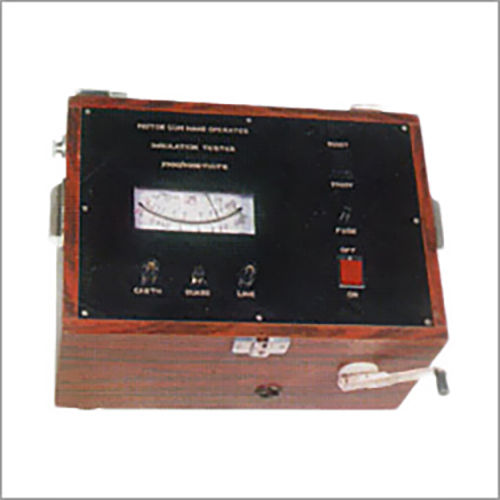
About Inslutation Tester Hand driven Generator type
Insutation Tester
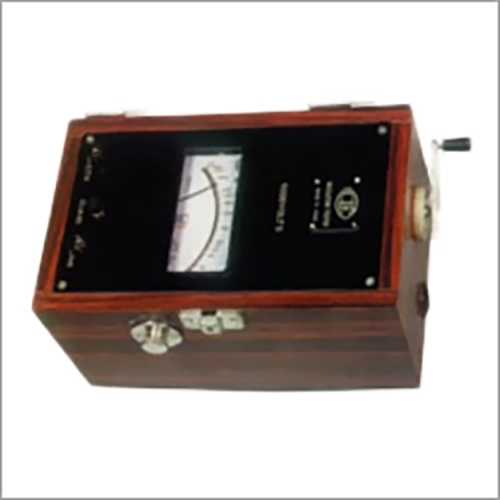
- Insulation tester, wooden body
- Scale length : 100mm (approx.)
- Rotation speed : 160 or more r.p.m.
- Weight : 4.1 kg (approx.)
- Dimensions (in mm) : 265x165x185 (approx.)
- Accuracy ; as per iss : 2992 - 1987
- Ranges available: available from 100 v to 5000 v dc o/p voltage with suitable resistance range. Multiple ranges available at options provided with range selector switch
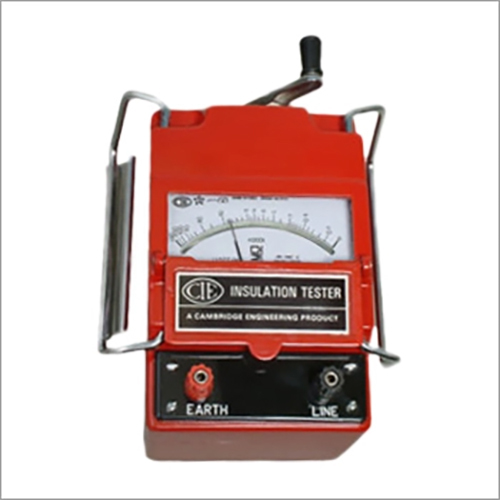
Efficient Manual OperationThe insulation tester employs a hand-driven generator with a foldable metal crank, eliminating the need for batteries. This makes it highly suitable for on-site use where power sources may be limited, ensuring continuous operation anywhere.
Accurate Analog DisplayThe analog meter features a mirror scale with clear, distinct markings, helping users avoid parallax errors and enhancing reading accuracy. This is especially useful for professionals who require precise insulation resistance values during testing.
Robust, Long-Lasting DesignConstructed with high-grade plastic, metal, and Bakelite, the tester is engineered to withstand tough working conditions. It boasts weatherproof and corrosion-resistant properties, with shock and impact resistance, safeguarding the instrument during regular handling.
FAQs of Inslutation Tester Hand driven Generator type:
Q: How do I operate the insulation tester without batteries?
A: You simply rotate the folding metal crank to generate the required test voltage. This hand-driven process powers the analog meter, making the device ideal for fieldwork where electricity is unavailable.
Q: What types of insulation resistance problems can this tester help detect?
A: The tester is suited for checking insulation in industrial and domestic installations, equipment, cables, and machinery, identifying faults, deterioration, or leakage currents that may compromise safety and performance.
Q: When should insulation resistance be tested using this device?
A: It should be used during routine maintenance, installation checks, troubleshooting, or before commissioning new electrical systems to ensure proper insulation and compliance with safety standards.
Q: Where is this tester typically utilized?
A: Electricians, maintenance engineers, and utility technicians use it commonly in factories, utility stations, construction sites, and residential settings to verify insulation integrity.
Q: What process should I follow to measure insulation resistance with this instrument?
A: Connect the brass terminals securely to the item under test, select the desired test voltage using the selector, and crank the handle to generate power. Read the resistance directly on the analog mirror scale for accurate results.
Q: What are the main benefits of using this insulation tester?
A: Key advantages include its battery-free operation, high accuracy, robust weatherproof build, overload protection, and ergonomic features such as a built-in carrying handle and clear display, all contributing to safe and efficient electrical testing.





 Send Inquiry
 Get Latest Price

